The crazy woman next – door


conversation with Alda Merini

Alda Merini tells her life in a personal and familiar narrative, fluctuating between public and private, lingering on the most significant chapters of her existence: childhood, womanhood, love, maternity and the relationship with her children, madness and the lucid reflection on poetry and art. The face of the poetess and the details of her eyes, hands, and body create a portrait that does not hide the contradictions of one of the most important and renowned literary figures of the twentieth century.

Director’s statement
Ever since i made Ogni sedia ha il suo rumore in 1995, i have always wanted to retrieve the precious unused footage from the encounter with Alda Merini. At the time, that material was entwined with Licia Maglietta’s performance, inevitably cutting out parts of the conversation with Alda Merini. This footage was recovered almost twenty years later thanks to the collaboration of Rai Cinema, becoming The crazy woman next-door, which restores that extraordinary encounter in its entirety
Antonietta De Lillo
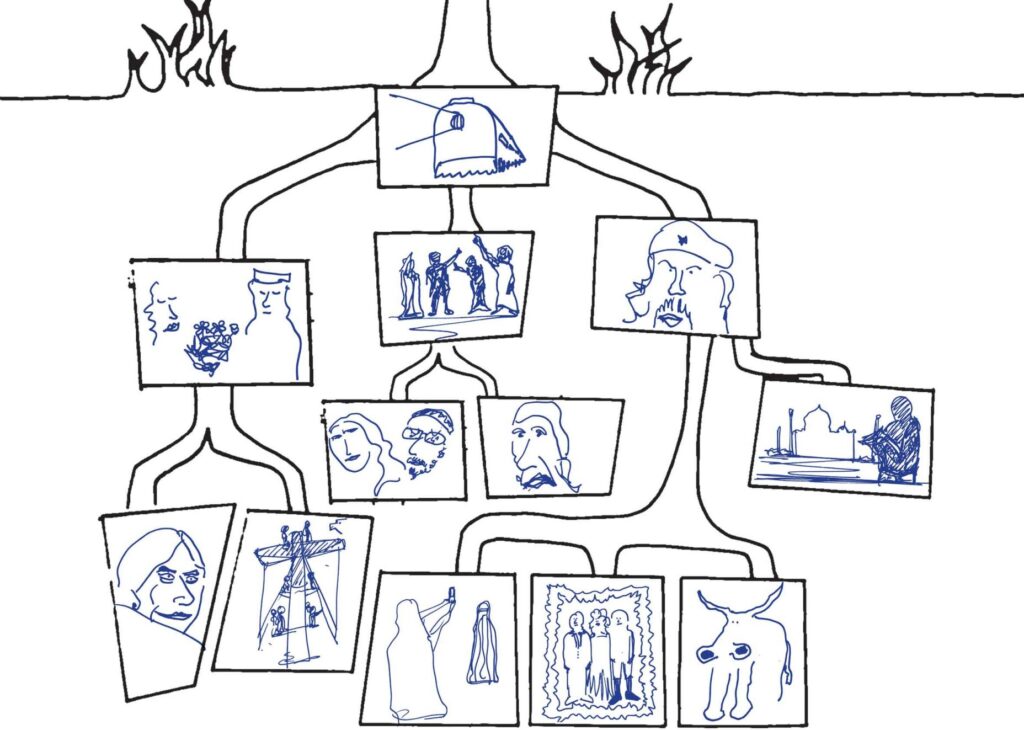
 

FILI INVISIBILI

Elena con la piccola Benedetta, la prima figlia nata in Italia, nel 1993 va a vivere in India dove sposa Baba Ji, col quale ha altri tre figli. Il fratello Manolo, maestro di sci, sposa dopo vent’anni una sua ex allieva belga ed hanno una figlia, Clara, che ha 6 anni e vive tra Bruxelles (insieme al fratello adottivo Alexandre, etiope, oggi sedicenne) e Alagna, piccolo comune delle Alpi. Una famiglia che abbraccia il mondo intero. Il viaggio del regista inizia dall’India dove vola ad incontrare l’amica Elena che non vede da 18 anni, e poi a Bruxelles, dove vive Clara.

Seguendo l’indicazione dello scrittore Orhan Pamuk “Le storie individuali sono di gran lunga più adatte a illustrare quanto sia profonda la nostra umanità”, il regista Andrea Papini ha realizzato un “appunto a matita” su una eccentrica famiglia di amici. Riprese realizzate con una piccola videocamera, che meritano di essere editate e mostrate a un pubblico più vasto di quello familiare. Sono scritti veloci e imprecisi, ma realizzati con la grafite, che contiene il carbonio, la materia della vita.

A house on a knife – edge

In a c minor trio, a viola d’amore, a cello and a violin are capable of grasping the unforseeable from life and still play with its possibilities.

Giovanni (Luigi Pistilli) a womanizer enamoured of life, Teo (Riccardo Cucciola) an old school chum and meticulous collection of watches, and Maria (Marina Vlady) a childhood sweetheart, always ready to help her fellow compatriots in Italy, inherit an apartment in Rome. After an arduous beginning, this casual cohabitation brings new energies to the lives of all three.  The sudden death of one of them puts the surviving two in a quandary: should they cancel this experience and go back to the dreariness of their destinies, or rather continue on the path they have embarked upon towards a future together? 

The remains of nothing

It is as if De Lillo and De Medeiros were confronting and chasing after each other until they became a sole person in the throes of a marvelous utopia.
Bernardo Bertolucci

Portuguese noblewoman Eleonora Pimentel Fonseca,  the voice of the 1799 Neapolitan Revolution, together with other young Neapolitan aristocrats, battles for the ideals of equality, liberty and fraternity. All too soon, the blade of the Restoration falls on the founders of the short-lived Republic: their dream, which had briefly become reality, is shattered into thousands of pieces. The remains of nothing…”il resto è niente.”
The film chooses to recount the human and political events of Naples at the end of the 18th century by illustrating the precious hours preceding Eleonora’s death. The camera is set at the center of her soul, to record the suffering, hopes and passions of her entire life. Thus, the portrait of a courageous woman, modern and free, is created through the threads of memory.

Dr. Lucio Fulci’s day-for-night

A classic horror film? But it was I who made the classics!” interview with Lucio Fulci, master of this film genre.

A document/legacy of the great Lucio Fulci, master of the B-movie, whose work has inspired world famous directors such as Quentin Tarantino. Lucio Fulci treats us to a lengthy consideration on his way of doing cinema and his eccentric career, which is fascinating for its sincerity, irony and clearness of mind.

Angelo Novi, movie stills photographer

A journey into the memoir of our cinema through the words and images of Angelo Novi.

The film is a journey into the memoir of our cinema, from the years after the Second World War to the end of the twentieth century. The photographs Angelo Novi took on the sets of Pasolini, Rossellini, Leone and Bertolucci are commented by the original sound tracks of the films and by the same photographer who describes the precise moment he snapped them. We get to know one of the most important witnesses of Italian cinema through his tales that are full of anecdotes and emotion.