


La violenza sulla donna, che trova il suo apice nel femminicidio, non ha una matrice dominante. Non c’è un censo, una cultura, una prossimità, o un’esperienza di violenze che inneschi un rapporto causa/effetto ben identificabile. Il fenomeno è trasversale, colpisce nei luoghi più imprevisti e dilaga, emergendo dalle paludi della reticenza, solo in proporzione al grado di emancipazione raggiunto dalle donne. L’episodio è ispirato a un fatto di cronaca accaduto in provincia di Napoli nel luglio 2012.

Non dubitare mai che un piccolo gruppo di cittadini coscienziosi ed impegnati possa cambiare il mondo. In verità è l’unica cosa che è sempre accaduta. Margaret Mead
UN CITTADINO non è un romanzo, non è un documentario, è una piccola pagina di quello che ciascuno di noi, se crede alle proprie convinzioni, può fare. Così come l’avvocato Aldo Bozzi, da solo con i suoi 26 amici avvocati, è riuscito a far dichiarare incostituzionale una legge elettorale che sentiva ledere alcuni dei nostri diritti fondamentali.
Speriamo che questo lavoro sia il primo di una serie di mini ritratti d’autore, in bilico tra cinema e giornalismo, per dar voce ai sentimenti che hanno mosso azioni in campo sociale, politico, culturale, che meritano di essere raccontate.
Speriamo che questo lavoro sia il primo di una serie di mini ritratti d’autore, in bilico tra cinema e giornalismo, per dar voce ai sentimenti che hanno mosso azioni in campo sociale, politico, culturale, che meritano di essere raccontate.

Un viaggio in un immaginario futuro che stiamo contaminando
Note di Regia
Quando, tempo fa, ho letto un articolo del geologo Giovanni Balestri che profetizzava, fatti alla mano, la fine della vita nella mia terra nel 2064, ho sentito l’esigenza di raccontare questo fenomeno mediante la settima arte. Certamente un lavoro cinematografico non può avere la pretesa di proporsi come panacea della drammaticità sociale che il fenomeno sta generando ma, come sempre, il cinema può dare un prezioso contributo alla campagna di sensibilizzazione che si sta mettendo in atto. Maria Di Razza
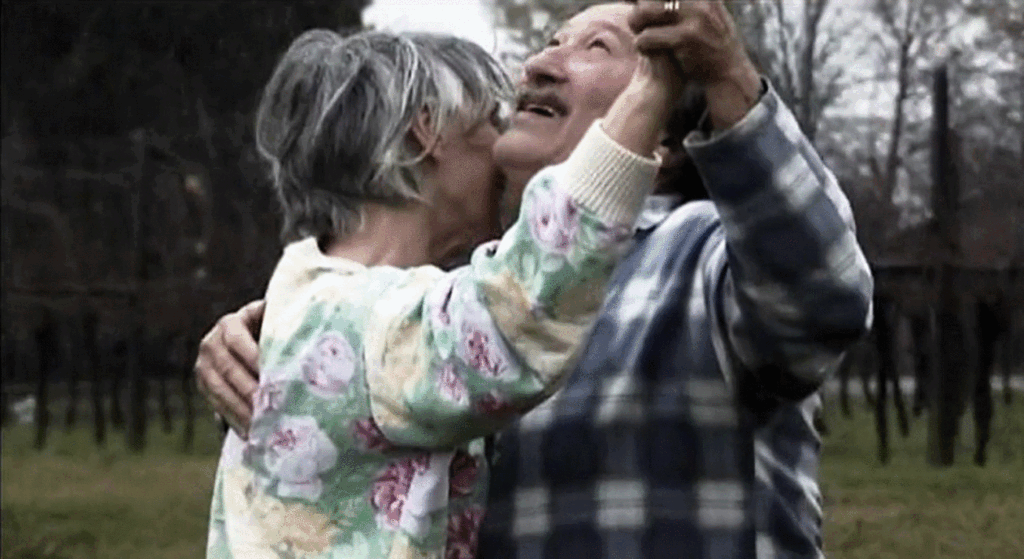
Today Together, Tomorrow Too is a compositionof faces, places and stories collected by different directors throughout Italy. OIDA – participated film conceived and curated by Antonietta De Lillo – composes a portrait of love at our times through fragments of different materials – documentaries, investigations, animations and found footage.
The casualness and the normalcy of the stories that we can see in this documentary are the key to express the most elusive of all feelings – love. The result is a complex image, that represents the density of our relationships in this moment of crisis and social transformations in which we live.
Forty years have gone by since the Italian referendum on divorce and Pier Paolo Pasolini’s Love Meetings. Today Together, Tomorrow Too investigates the feeling of love portraying the changes in our country – the breakdown of marriage and traditional family values, the human and economic crisis, the lack of work, the change of sexual behaviour, the bio-technologic revolution, the growth of immigration and the difficulty in confronting cultures that are different from our own.
We chose to startfrom the darkest aspects of love -abandonment, intolerance, violence and hate. Through the street interviews and the stories collected by the directors that participated in the project, we will meet couples who have been together all their lives and people who have never met love, along withthe those who have to cope with the harsh feelings that usually follow a breakup. Traditional families, enlarged families, exploded families, recomposed families, new balances made of people who are willing to stay together even after their stories are over. Different forms of love, sometimes more fragile, sometimes more powerful and free go togetherwith the vision of the youngest people interviewed, who search for an absolute pure and true love that might be free of social judgement and of conditioning based on age, culture and gender.
The participated film by marechiarofilm shows love in its widest form, meaning not only a relationship between two people, but also the love of parents for their children, love towards strangers and love as an opportunity to elevate ourselves beyond ourselves, our selfishness and our fears. It is a confirmation that in our selfish society more and more concentrated on cynic and individualistic models, love is still the most powerful energy moving things and is often the best antidote to our solitude.

The story of Luca is that of a 46 year-old photographer who has been forced to retire from life and love; it is also the story of many other people overwhelmed by isolation and the economic emergency. But Luca is also an artist who has begun writing a letter addressed both to an ideal love as well as to us all. He guides us in a cosmopolitan journey through experiences that are often more arduous than his and recounts the story of a person who is determined to carry on without anger while struggling not to be overcome by the events.

conversation with Alda Merini
Alda Merini tells her life in a personal and familiar narrative, fluctuating between public and private, lingering on the most significant chapters of her existence: childhood, womanhood, love, maternity and the relationship with her children, madness and the lucid reflection on poetry and art. The face of the poetess and the details of her eyes, hands, and body create a portrait that does not hide the contradictions of one of the most important and renowned literary figures of the twentieth century.
Director’s statement
Ever since i made Ogni sedia ha il suo rumore in 1995, i have always wanted to retrieve the precious unused footage from the encounter with Alda Merini. At the time, that material was entwined with Licia Maglietta’s performance, inevitably cutting out parts of the conversation with Alda Merini. This footage was recovered almost twenty years later thanks to the collaboration of Rai Cinema, becoming The crazy woman next-door, which restores that extraordinary encounter in its entirety
Antonietta De Lillo

Songs and the testimony of the Saharawi people in the actuality of their exile.
For over thirty years the Saharawi people have been living in the Nigerian desert, struggling to be recognized and regain their land that had been appropriated by Morocco.Through traditional songs and images of life in the desert, the film gives voice to a people who, with dignity and determination, are only asking to exist and return to their homelands by the sea.

If ‘E Zezi didn’t exist, I’d go crazy. The factory, the bar and the news on TG3: that’s my whole day. When I sing with ‘E Zezi, I feel good.
Miciariello, alias Sebastiano Ciccarelli
‘E Zezi, is a historic musical group from the Neapolitan hinterland, prevalently consisting of automobile workers from the Alfasud plant in Pomigliano d’Arco. Through their music – tarantellas, tammurriatas and fronnes – they describe their world and its transformation from an agricultural society to an industrial one. Theirs is a music that links the ancient to the new with incredible vitality. A powerful visceral music that has become a political instrument for social reform.

Death belongs to us and its concept must go back to the very core of life.
The film is divided into three episodes in which a struggle with death is represented in different ways. In the first episode, entitled Holes of Love (Pozzi d’amore), the protagonist Enzo Moscato recites a sort of theatrical monologue. A long tale in which he speaks about the fear of an imminent death and the anguish related to the forthcoming separation from a beloved one. On the contrary, in the second episode, Upper Left Corner (In alto a sinistra) a young man meditates upon his father’s death. He recalls how his father had suffered during his terminal illness and, precisely in the name of that reminiscence, he can finally overcome the lacerating pain that accompanied his solitude.
In the last episode, Vittoria’s Tales (Racconti di Vittoria), oncologist Vittoria has contracted cancer, and from within the disease, she encourages her patients with great courage and dignity to fight for their lives. The leitmotiv of the film, suffering and death, is viewed from three different perspectives: the theatre, literature and television. The aim of the film is to exorcize death with a myth in the first episode, to ritualize it in the second and finally in the last case, to contend with death by looking it straight in the face.

The love story of a couple in which he had been a she.
A testimony of the force of love that binds two people, a present-day betrothed couple.
The narration proceeds as a thriller in which the two protagonists conceal a mystery: visible traces, scars on an arm, details that worm their way into the story until the enigma is revealed. He had previously been a she.
A contemporary metamorphosis made possible by their love.