A house on a knife – edge

In a c minor trio, a viola d’amore, a cello and a violin are capable of grasping the unforseeable from life and still play with its possibilities.

Giovanni (Luigi Pistilli) a womanizer enamoured of life, Teo (Riccardo Cucciola) an old school chum and meticulous collection of watches, and Maria (Marina Vlady) a childhood sweetheart, always ready to help her fellow compatriots in Italy, inherit an apartment in Rome. After an arduous beginning, this casual cohabitation brings new energies to the lives of all three.  The sudden death of one of them puts the surviving two in a quandary: should they cancel this experience and go back to the dreariness of their destinies, or rather continue on the path they have embarked upon towards a future together? 

Planet Tonino

At my age I don’t like hardly anything about myself, or about others. I want the dirtiest, the wrongest, the most interrupted stuff. While we speak a camel is going by. There…I wish it were like that.
Tonino Guerra

Portrait of Tonino Guerra, one of the most prominent Italian screenwriters, author for world-famous directors such as: Fellini, Tarkovski, Antonioni, the Taviani brothers, Mikailkov. The documentary goes back through his career as a screenwriter and shows his everyday life at Pennabilli.  In this tiny village near Rimini, Tonino Guerra has succeeded in constructing a world in his image and likeness through the realization of a series of works-signs which express his indomitable vitality and creativity: fountains, road signs, “thinking” gardens. It is an encounter with a man who possesses an enormous vital force, with which he reconstructs his “fables” in order to defeat boredom and the predictability of everyday life

O sole mio

The history and success of the song ‘O sole mio, a world famous classic.

A tale that peers behind the clichés of Naples, too often defined only as “sole-pizza-amore” (sun-pizza-love). Through the history of the song ‘O sole mio, from its birth in 1898 to its consecration, the film narrates the two faces of Naples: on the one hand the paradisiacal, luminous postcard-city, on the other hand, the dark mysterious Naples of the vicoli (the alleys). A kaleidoscope consisting of evidence ranging from the era of silent movies to our days, with the celebrated interpretations of Mario Del Monaco, Elvis Presley, Luciano Pavarotti, Sergio Bruni, and occasional performers such as Paul McCartney and the Spice Girls.

Maruzzella

The encounter of two solitudes: a transsexual and a young woman in a red-light cinema.

Maruzzella is a transvestite who haunts the corridors of red-light cinemas like a modern Phantom of the Opera, offering his clients very unusual sexual performances until he encounters a young woman, a desolate viewer of hard films, who will radically change the life of our protagonist.


Each Chair has its own Sound

I fell in love twenty-six times, I relapsed. As  many were the falls, so many were the poems.
Alda Merini


Alda Merini, one of the most important poets of the twentieth century confesses herself without inhibitions, recounting her life of suffering. This portrait alternates conversation with fragments of her poetry interpreted by Licia Maglietta (taken from her theatrical performance Love Delirium/Delirio amoroso).The encounter of these two women and their artistic fusion render for us the fragility and the greatness of a woman who had been overwhelmed by an excess of love.

Matilda

Is Matilda a jinx? A black comedy with a surprise ending.

Is Matilda a jinx? After the mysterious accidental deaths of  three boyfriends, Matilda, who is eager to marry, runs a matrimonial ad in the papers, which is answered by dithering Torquato (Silvio Orlando), who cannot resist her charm. Ignoring the misfortunes of her previous boyfriends, he is headed towards a destiny that promises to be lethal. The film is a black comedy with a surprise ending.

It’s not fair

The adult world seen through the eyes of two eleven-year-olds.

Sofia and Valerio, aged 11 and 12, meet by chance in a semi-deserted Naples suffocating because of the summer heat. Both have been entrusted to the care of their fathers, a pair of forty-year-olds afflicted with every sort of sentimental and existential problems, while their mothers are far off, present only in brief telephonic incursions.  The two kids feel continually threatened by the instability and confusion of their families.  “It’s not fair…” they say as they join forces to face the adult world together with detachment and irony, so as to be no longer afraid of it.


Dr. Lucio Fulci’s day-for-night

A classic horror film? But it was I who made the classics!” interview with Lucio Fulci, master of this film genre.

A document/legacy of the great Lucio Fulci, master of the B-movie, whose work has inspired world famous directors such as Quentin Tarantino. Lucio Fulci treats us to a lengthy consideration on his way of doing cinema and his eccentric career, which is fascinating for its sincerity, irony and clearness of mind.

Angelo Novi, movie stills photographer

A journey into the memoir of our cinema through the words and images of Angelo Novi.

The film is a journey into the memoir of our cinema, from the years after the Second World War to the end of the twentieth century. The photographs Angelo Novi took on the sets of Pasolini, Rossellini, Leone and Bertolucci are commented by the original sound tracks of the films and by the same photographer who describes the precise moment he snapped them. We get to know one of the most important witnesses of Italian cinema through his tales that are full of anecdotes and emotion.

the social xmas

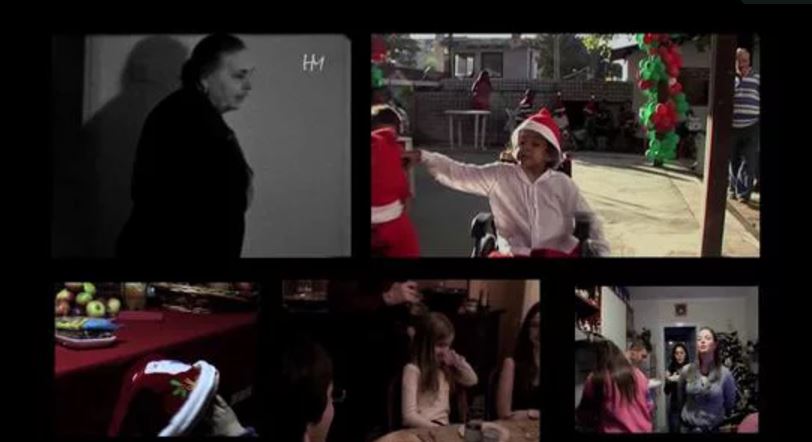
Il Pranzo di Natale, sperimentando la commistione di linguaggi diversi, riunisce immagini amatoriali e video realizzati da professionisti; è un remix di sorgenti molteplici ed eterogenee che insieme formano un racconto unitario, grazie a un montaggio che procede seguendo una linea di associazioni che di volta in volta cambiano, privilegiando in alcuni casi legami musicali, in altri cronologici,spesso emotivi. Le immagini così si susseguono, con una tessitura aperta tra il racconto lineare di un rito collettivo e l’associazione di storie e frammenti che interagiscono o si contrappongono tra loro, mostrando immagini attuali accostate a immagini del passato, vecchi filmini di famiglia affiancati ai video dei Natali presenti.

L’attrice Piera degli Esposti, in un ruolo deliberatamente in bilico tra persona e personaggio, evidenzia i momenti peculiari del racconto e ne scandisce il tempo. I “Natali” narrati sono vari: c’è quello ingenuo e felice di un bambino che aspetta i regali da Babbo Natale, quello rassegnato e “nero “ di chi ormai ha perso tutto, quello festeggiato in solitudine e quello in comunità…I treni sono affollati di persone e desideri che raggiungono i propri cari per l’irrinunciabile pranzo di Natale. Le immagini, apparentemente frammentate, diventano lo specchio integro di una società in crisi, dal quale emerge però l’immagine di un’umanità onesta che, con orgoglio, manifesta la forza e la volontà di reagire.