Vittoria’s tales

Death belongs to us and its concept must go back to the very core of life.

The film is divided into three episodes in which a struggle with death is represented in different ways. In the first episode, entitled Holes of Love (Pozzi d’amore), the protagonist Enzo Moscato recites a sort of theatrical monologue.  A long tale in which he speaks about the fear of an imminent death and the anguish related to the forthcoming separation from a beloved one. On the contrary, in the second episode, Upper Left Corner (In alto a sinistra) a young man meditates upon his father’s death.  He recalls how his father had suffered during his terminal illness and, precisely in the name of that reminiscence, he can finally overcome the lacerating pain that accompanied his solitude.
In the last episode, Vittoria’s Tales (Racconti di Vittoria), oncologist Vittoria  has contracted cancer, and from within the disease, she encourages her patients with great courage and dignity  to fight for their lives. The leitmotiv of the film, suffering and death, is viewed from three different perspectives: the theatre, literature and television. The aim of the film is to exorcize death with a myth in the first episode, to ritualize it in the second and finally in the last case, to contend with death by looking it straight in the face.


O sole mio

The history and success of the song ‘O sole mio, a world famous classic.

A tale that peers behind the clichés of Naples, too often defined only as “sole-pizza-amore” (sun-pizza-love). Through the history of the song ‘O sole mio, from its birth in 1898 to its consecration, the film narrates the two faces of Naples: on the one hand the paradisiacal, luminous postcard-city, on the other hand, the dark mysterious Naples of the vicoli (the alleys). A kaleidoscope consisting of evidence ranging from the era of silent movies to our days, with the celebrated interpretations of Mario Del Monaco, Elvis Presley, Luciano Pavarotti, Sergio Bruni, and occasional performers such as Paul McCartney and the Spice Girls.

Each Chair has its own Sound

I fell in love twenty-six times, I relapsed. As  many were the falls, so many were the poems.
Alda Merini


Alda Merini, one of the most important poets of the twentieth century confesses herself without inhibitions, recounting her life of suffering. This portrait alternates conversation with fragments of her poetry interpreted by Licia Maglietta (taken from her theatrical performance Love Delirium/Delirio amoroso).The encounter of these two women and their artistic fusion render for us the fragility and the greatness of a woman who had been overwhelmed by an excess of love.

the social xmas

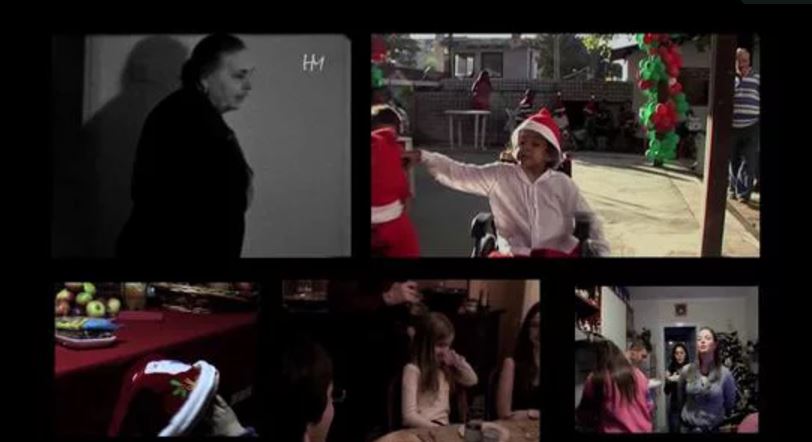
Il Pranzo di Natale, sperimentando la commistione di linguaggi diversi, riunisce immagini amatoriali e video realizzati da professionisti; è un remix di sorgenti molteplici ed eterogenee che insieme formano un racconto unitario, grazie a un montaggio che procede seguendo una linea di associazioni che di volta in volta cambiano, privilegiando in alcuni casi legami musicali, in altri cronologici,spesso emotivi. Le immagini così si susseguono, con una tessitura aperta tra il racconto lineare di un rito collettivo e l’associazione di storie e frammenti che interagiscono o si contrappongono tra loro, mostrando immagini attuali accostate a immagini del passato, vecchi filmini di famiglia affiancati ai video dei Natali presenti.

L’attrice Piera degli Esposti, in un ruolo deliberatamente in bilico tra persona e personaggio, evidenzia i momenti peculiari del racconto e ne scandisce il tempo. I “Natali” narrati sono vari: c’è quello ingenuo e felice di un bambino che aspetta i regali da Babbo Natale, quello rassegnato e “nero “ di chi ormai ha perso tutto, quello festeggiato in solitudine e quello in comunità…I treni sono affollati di persone e desideri che raggiungono i propri cari per l’irrinunciabile pranzo di Natale. Le immagini, apparentemente frammentate, diventano lo specchio integro di una società in crisi, dal quale emerge però l’immagine di un’umanità onesta che, con orgoglio, manifesta la forza e la volontà di reagire.