

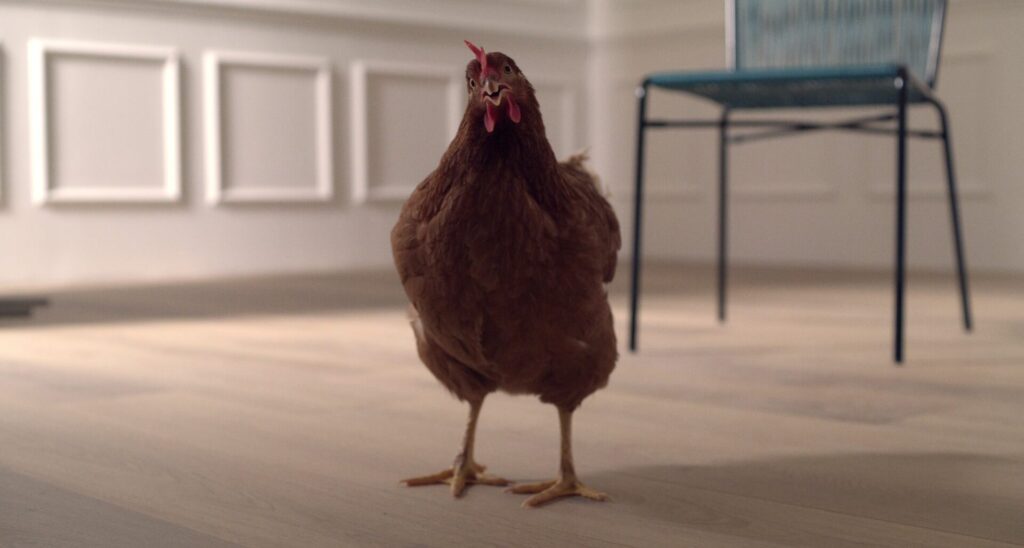
The Eye of the Hen is the cinematic self-portrait of director Antonietta De Lillo, relegated to the margins of the film industry after a legal dispute over the distribution of her most successful film, which could have established her in the mainstream. The story of the protagonist’s public and private life, through interviews, reconstructions, and personal, cinematographic, and television archives, shows the difficulties of going against the tide and the creativity and resilience needed to reinvent oneself with the means at one’s disposal. The film is a narrative that suggests methods to overcome isolation isolation by celebrating cinema in its communal, cultural, and political role.
I wasn’t looking for freedom. Only a way out. Franz Kafka
Synopsis
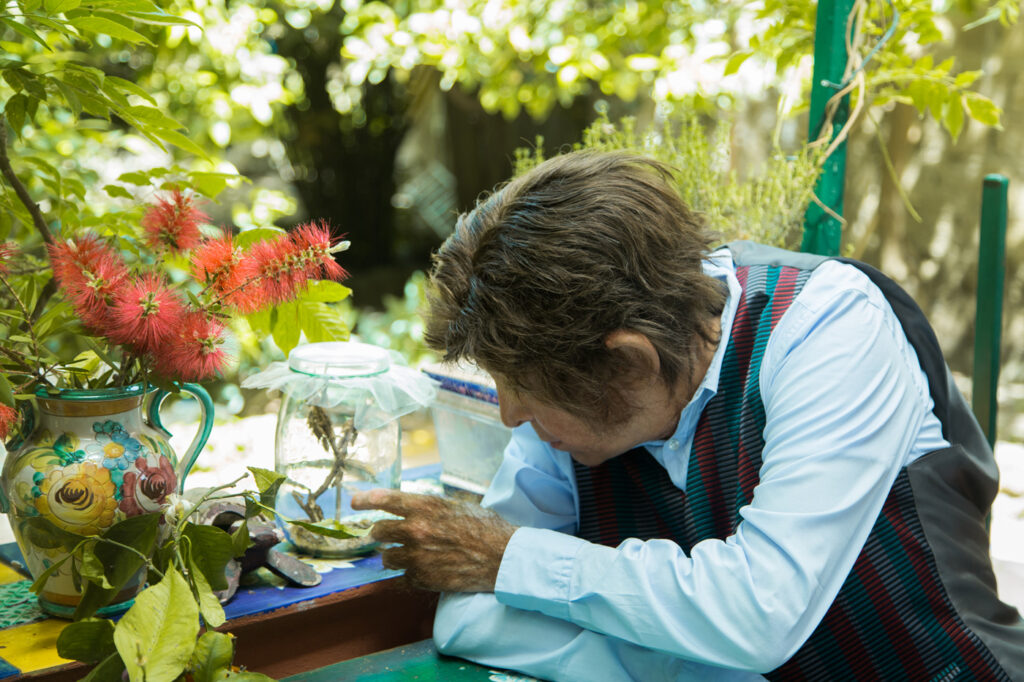
In 1917, a short novel by Franz Kafka appeared on a magazine. It is called A Report to an Academy, the story of Mr Rotpeter, a monkey who transformed into a man. During his academical report, Mr Rotpeter talks about his metamorphosys. Mr Rotpeter’s imaginary portrait by Antonietta De Lillo runs two levels: the fragments of the kafkian lesson, as his past, and the interview, as his present. Antonietta De Lillo creates a cinematographic character that brings in universal topics such as freedom and survival, drawing a contemporary portrait of our society. Through her peculiar narration, Antonietta De Lillo imagines a “neapoletan” Mr Rotpeter: he walks through the streets of Naples, in Molosiglio’s gardens, he climbs the stairs of the prestigious University of Naples Federico II, he observes families playing on the grass on a sunday morning in Capodimonte’s wood. At the end he gives to an imaginary journalist a long interview. Though Mr Rotpeter is a fantastic character, between a beast and a man, the power of cinema is to create the illusion of reality. Mr Rotpeter could be an ordinary person one could meet on the street by chance. Mr Rotpeter’s reflections on our times put the spectators in front of a mirror and allow them to reflect themselves with him and his metamorphosys.
Director’s statement
Everyhting started when Marcello Garofalo invited me to watch a theatre performance of the kafkian A Report to an Academy, created and played by Marina Confalone, one of the greatest italian actresses. So I went to see her show in the famous Federico II University of Naples. I started to imagine a contemporary Rotpeter, set in a nowaday Naples, and I wanted to let him free from the written paper and make him alive through a long interview. With all the peculiarities of a fiction film I made my first portrait to an imaginary character born from a writer’s pen. What fascinated me about Mr Rotpeter was his desperate search for a way out. That was my starting point. Together with Marcello Garofalo I started to imagine an integrated Rotpeter, whose achievemet of a way out led him to a survival, not to freedom. Rotpeter is a creature between a beast and a man, he talks about our human condition through his personal experience. Rotpeter is forced to observe and imitate a world that imprison him, in order to adapt and survive. As well as him, we human beings are often forced to adapt to a society that is more and more subdued to economical powers, causing our loss of freedom and humanity. The “neapoletan” Mr Rotpeter fights his own personal cause for survival but, at the end of a long imaginary conversation, he has the need to fight for others too. I believe that we should listen to Mr Rotpeter’s desire, if we want to emancipate ourself from a condition that degenerates our nature. Antonietta De Lillo
UPCOMING streaming
Synopsis
In 1917, a short novel by Franz Kafka appeared on a magazine. It is called A Report to an Academy, the story of Mr Rotpeter, a monkey who transformed into a man. During his academical report, Mr Rotpeter talks about his metamorphosys. Mr Rotpeter’s imaginary portrait by Antonietta De Lillo runs two levels: the fragments of the kafkian lesson, as his past, and the interview, as his present. Antonietta De Lillo creates a cinematographic character that brings in universal topics such as freedom and survival, drawing a contemporary portrait of our society. Through her peculiar narration, Antonietta De Lillo imagines a “neapoletan” Mr Rotpeter: he walks through the streets of Naples, in Molosiglio’s gardens, he climbs the stairs of the prestigious University of Naples Federico II, he observes families playing on the grass on a sunday morning in Capodimonte’s wood. At the end he gives to an imaginary journalist a long interview. Though Mr Rotpeter is a fantastic character, between a beast and a man, the power of cinema is to create the illusion of reality. Mr Rotpeter could be an ordinary person one could meet on the street by chance. Mr Rotpeter’s reflections on our times put the spectators in front of a mirror and allow them to reflect themselves with him and his metamorphosys.
Director’s statement
Everyhting started when Marcello Garofalo invited me to watch a theatre performance of the kafkian A Report to an Academy, created and played by Marina Confalone, one of the greatest italian actresses. So I went to see her show in the famous Federico II University of Naples. I started to imagine a contemporary Rotpeter, set in a nowaday Naples, and I wanted to let him free from the written paper and make him alive through a long interview. With all the peculiarities of a fiction film I made my first portrait to an imaginary character born from a writer’s pen. What fascinated me about Mr Rotpeter was his desperate search for a way out. That was my starting point. Together with Marcello Garofalo I started to imagine an integrated Rotpeter, whose achievemet of a way out led him to a survival, not to freedom. Rotpeter is a creature between a beast and a man, he talks about our human condition through his personal experience. Rotpeter is forced to observe and imitate a world that imprison him, in order to adapt and survive. As well as him, we human beings are often forced to adapt to a society that is more and more subdued to economical powers, causing our loss of freedom and humanity. The “neapoletan” Mr Rotpeter fights his own personal cause for survival but, at the end of a long imaginary conversation, he has the need to fight for others too. I believe that we should listen to Mr Rotpeter’s desire, if we want to emancipate ourself from a condition that degenerates our nature. Antonietta De Lillo
Sinossi
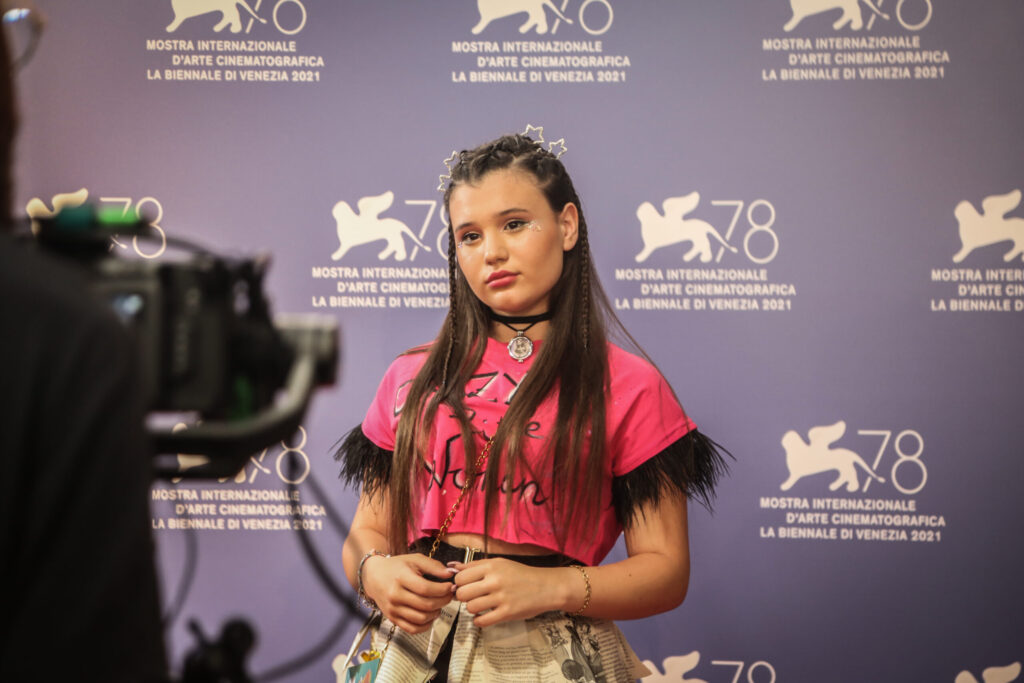
Vittoria è un’esuberante ragazzina di tredici anni che vive nella periferia di Napoli e sogna di diventare influencer. Suo padre, l’istrionico Fabrizio, per il suo compleanno, le regala un biglietto per sfilare sul red carpet di Venezia.
Inizia una preparazione bizzarra: abiti composti da ritagli di giornale, manicure, ricerca di outfit combinati, occhiali, lenti a contatto colorate e tante, tantissime storie sui social!
Ma il giorno dell’agognato red carpet, l’auto di Fabrizio, in autostrada, prende una svolta inaspettata…

Un viaggio in un immaginario futuro che stiamo contaminando
Note di Regia
Quando, tempo fa, ho letto un articolo del geologo Giovanni Balestri che profetizzava, fatti alla mano, la fine della vita nella mia terra nel 2064, ho sentito l’esigenza di raccontare questo fenomeno mediante la settima arte. Certamente un lavoro cinematografico non può avere la pretesa di proporsi come panacea della drammaticità sociale che il fenomeno sta generando ma, come sempre, il cinema può dare un prezioso contributo alla campagna di sensibilizzazione che si sta mettendo in atto. Maria Di Razza

O’cinema, as we used to say euphorically when we were kids. Each time it was an encounter with unbridled fantasy that gave us the possibility of travelling full speed through all the worlds of possibility.”
Enzo Moscato
A young Neapolitan takes a walk through his city. He gazes at the people as well as the things about him with curiosity and transfigures them, at times drawing us into the personal, at times the cinematographic, world of imagination. The evocative power of sounds, visual impressions and old film clips come together in this journey into the heart of Naples. The union of reality and fantasy is a pretext for reassembling the fragments of the history of a city and its wonderful cinema.
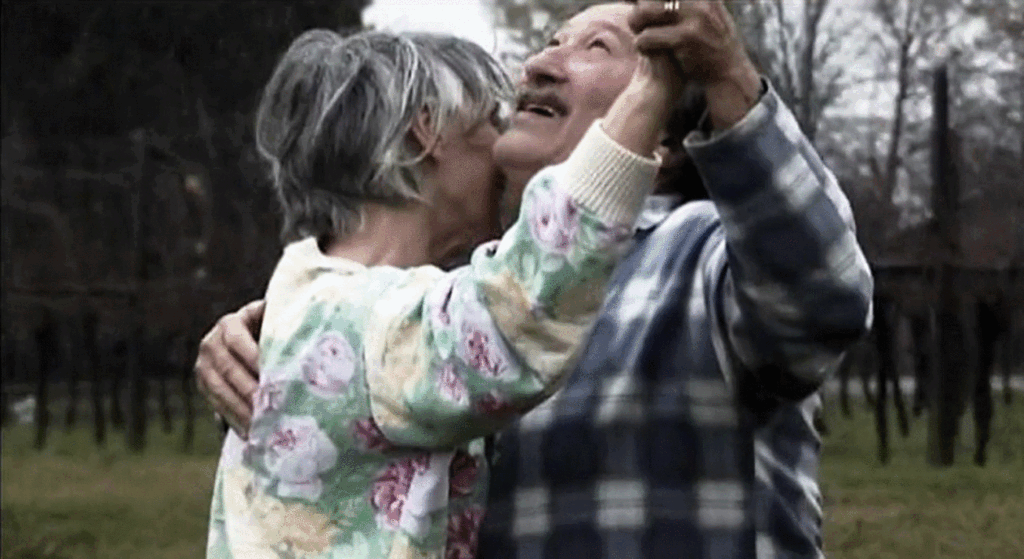
Today Together, Tomorrow Too is a compositionof faces, places and stories collected by different directors throughout Italy. OIDA – participated film conceived and curated by Antonietta De Lillo – composes a portrait of love at our times through fragments of different materials – documentaries, investigations, animations and found footage.
The casualness and the normalcy of the stories that we can see in this documentary are the key to express the most elusive of all feelings – love. The result is a complex image, that represents the density of our relationships in this moment of crisis and social transformations in which we live.
Forty years have gone by since the Italian referendum on divorce and Pier Paolo Pasolini’s Love Meetings. Today Together, Tomorrow Too investigates the feeling of love portraying the changes in our country – the breakdown of marriage and traditional family values, the human and economic crisis, the lack of work, the change of sexual behaviour, the bio-technologic revolution, the growth of immigration and the difficulty in confronting cultures that are different from our own.
We chose to startfrom the darkest aspects of love -abandonment, intolerance, violence and hate. Through the street interviews and the stories collected by the directors that participated in the project, we will meet couples who have been together all their lives and people who have never met love, along withthe those who have to cope with the harsh feelings that usually follow a breakup. Traditional families, enlarged families, exploded families, recomposed families, new balances made of people who are willing to stay together even after their stories are over. Different forms of love, sometimes more fragile, sometimes more powerful and free go togetherwith the vision of the youngest people interviewed, who search for an absolute pure and true love that might be free of social judgement and of conditioning based on age, culture and gender.
The participated film by marechiarofilm shows love in its widest form, meaning not only a relationship between two people, but also the love of parents for their children, love towards strangers and love as an opportunity to elevate ourselves beyond ourselves, our selfishness and our fears. It is a confirmation that in our selfish society more and more concentrated on cynic and individualistic models, love is still the most powerful energy moving things and is often the best antidote to our solitude.

The story of Luca is that of a 46 year-old photographer who has been forced to retire from life and love; it is also the story of many other people overwhelmed by isolation and the economic emergency. But Luca is also an artist who has begun writing a letter addressed both to an ideal love as well as to us all. He guides us in a cosmopolitan journey through experiences that are often more arduous than his and recounts the story of a person who is determined to carry on without anger while struggling not to be overcome by the events.

conversation with Alda Merini
Alda Merini tells her life in a personal and familiar narrative, fluctuating between public and private, lingering on the most significant chapters of her existence: childhood, womanhood, love, maternity and the relationship with her children, madness and the lucid reflection on poetry and art. The face of the poetess and the details of her eyes, hands, and body create a portrait that does not hide the contradictions of one of the most important and renowned literary figures of the twentieth century.
Director’s statement
Ever since i made Ogni sedia ha il suo rumore in 1995, i have always wanted to retrieve the precious unused footage from the encounter with Alda Merini. At the time, that material was entwined with Licia Maglietta’s performance, inevitably cutting out parts of the conversation with Alda Merini. This footage was recovered almost twenty years later thanks to the collaboration of Rai Cinema, becoming The crazy woman next-door, which restores that extraordinary encounter in its entirety
Antonietta De Lillo

The love story of a couple in which he had been a she.
A testimony of the force of love that binds two people, a present-day betrothed couple.
The narration proceeds as a thriller in which the two protagonists conceal a mystery: visible traces, scars on an arm, details that worm their way into the story until the enigma is revealed. He had previously been a she.
A contemporary metamorphosis made possible by their love.